


Admiral Chester W. Nimitz | Image Source: Nimitz Library, U.S. Naval Academy
Admiral Nimitz’s Battle Plan for Midway
The US intelligence unit on Midway had decrypted Japanese messages that detailed the battle plan for their Midway attack, and Admiral Chester Nimitz had this information by May 27, 1942. In intelligence officer Layton’s account, And I Was There, he told Nimitz, “…the carriers would probably attack on the morning of 4 June, from the northwest on a bearing of 325 degrees from Midway. They would be sighted by PBY scouts at about 175 miles from Midway at around 0700 local time.” (0600 on Midway.) Attack planes that flew from Midway immediately upon receiving the scouting report would intercept the Japanese at about 140 miles from Midway.
Nimitz had over a week to plan a concentration of force about 140 miles from Midway composed of carrier planes and the planes from Midway. The three U.S. carriers, Enterprise, Hornet and Yorktown, were to be at a point 140 miles northeast and perpendicular to the Japanese course of 325 degrees at the projected interception, a point that also is 200 miles directly north of Midway Island. PBY scouts were to fly at 0430 from Midway to confirm the operation on 3 June and again on 4 June. All the planes from both Midway and the carriers were to launch at around 0600 upon receipt of the PBY report confirming the Japanese fleet movements.
The action report of the U.S. carrier commander, Rear Admiral Frank Jack Fletcher, Enclosure H of CinCPacFlt report of 15 June 1942, states: “During the night of 3–4 June both forces (TF 17 and TF 16) proceeded to a point two hundred miles North of Midway.” Although this was Fletcher’s intention, he decided to pick up scouting planes that he had launched in the early hours of 4 June and was 50 to 70 miles away from the point 200 miles north of Midway at 0600. The carrier planes were out of their operating range of 175 miles, could not fly at the prescribed time, and the concentration of force failed. The Midway planes executed their portion of the plan but were badly outnumbered by Zeros and mostly shot down.
A Broken Play Leads to Victory
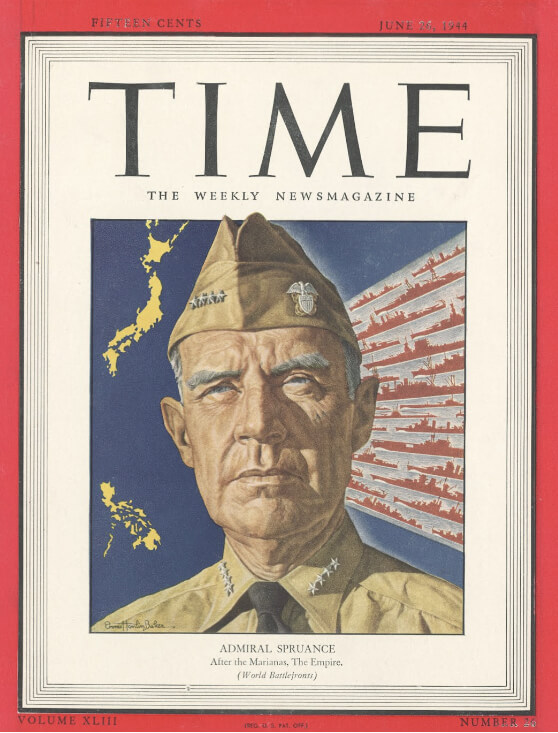
Admiral Raymond A. Spruance | Image Source: Google Arts & Culture
Rear Admiral Raymond Spruance, detached with Enterprise and Hornet, closed the range as quickly as possible and launched all available planes at maximum range. The Enterprise air group commander executed a search that saved the day and the battle at 1025, just before the Japanese were about to launch a deadly attack against the US carrier force. With this astounding victory no one was about to complain about not following the original Nimitz plan, least of all Nimitz. But make no mistake, the Midway victory was a broken play that was saved by the courage, judgement and execution of the finest of the US Navy.
Several historians who later conducted live interviews of naval officers involved in the Midway battle all confirmed that the US carriers were to be 200 miles north of Midway at 0600 on 4 June. See Richard Bates, The Battle of Midway, p. 108: Samuel Eliot Morison, Coral Sea, Midway, and Submarine Actions, p. 102; E.B. Potter, Nimitz, p. 8
We have the unsung heroes who flew from Midway to thank for their sacrifice that caused the Japanese admiral to deviate from his operating plan which contributed heavily to his ultimate defeat. The Midway planes also drew down whatever high-flying Japanese CAP had been at altitude, as there was no CAP to oppose the high B-17s when they made their fruitless attack at 0800. This opened the skies for the later dive bomber attacks that destroyed the Japanese carriers.
See the detailed account in Diplomats & Admirals by Dale A. Jenkins, available on Amazon.
Watch the Book Trailer for Diplomats & Admirals:
Click to Watch the Book Trailer!




0 Comments