
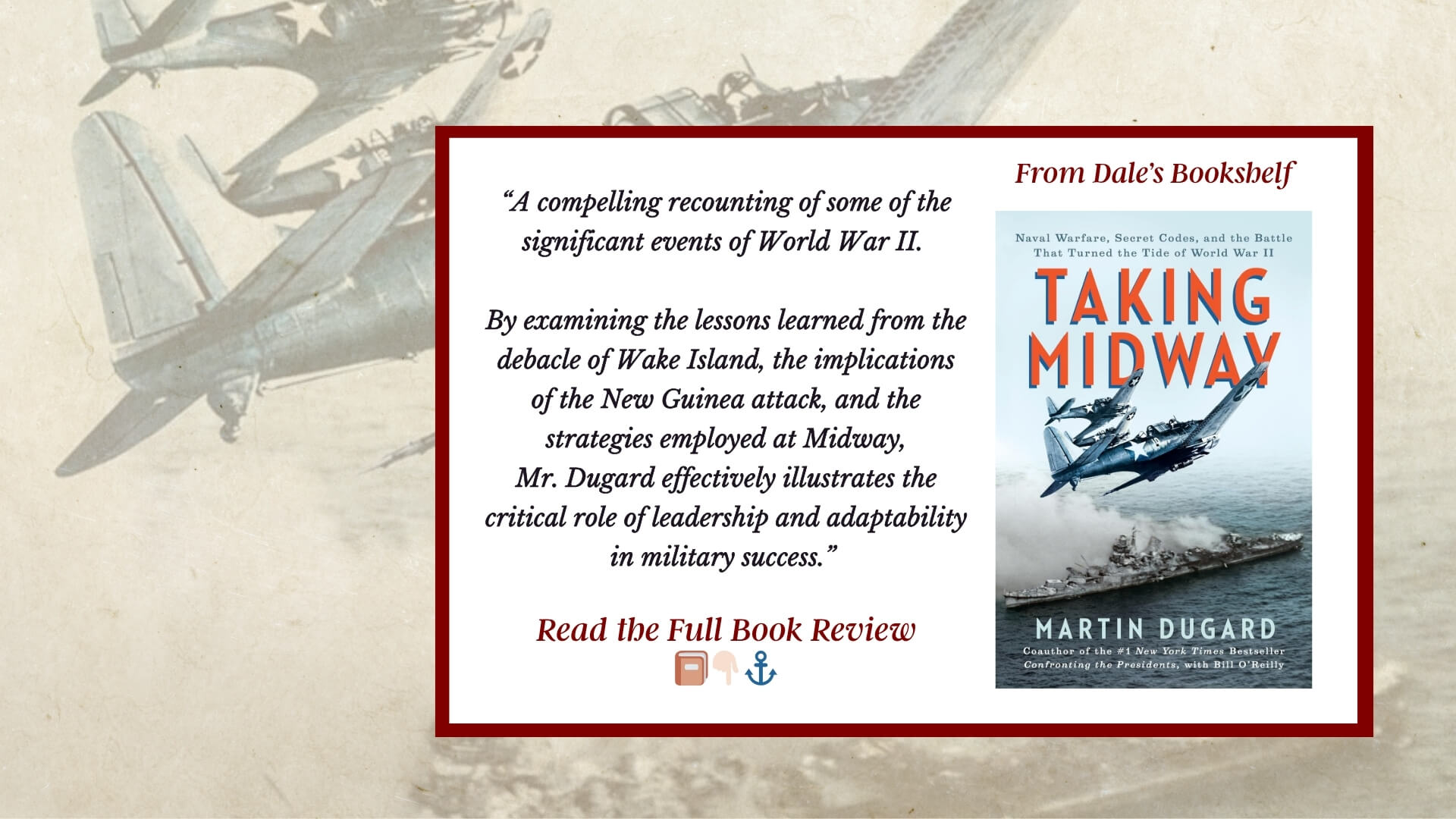
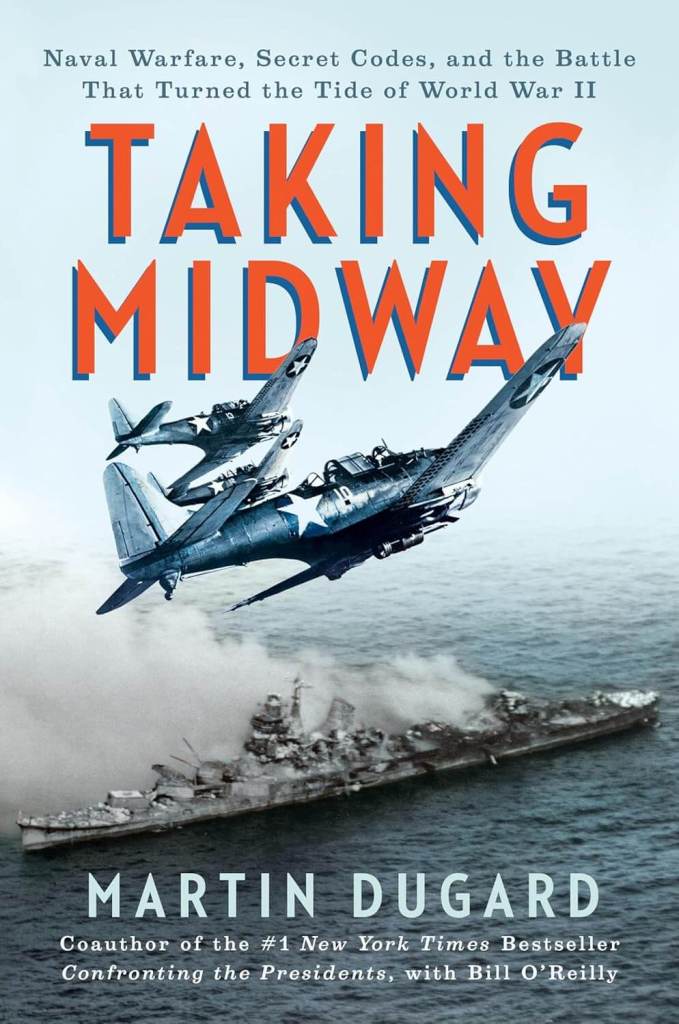
 Martin Dugard, Taking Midway, Dutton (Penguin Random House), 358 pages, 2025.
The latest in a series of books, Taking Midway follows Taking Berlin and Taking Paris with an engaging series of vignettes, anecdotes and narratives leading to the June 4, 1942 Midway battle that marked the high point of the Japanese expansion across the Pacific.
Mr. Dugard highlights the significance of the U.S. carrier attack on New Guinea on March 10, 1942 as a pivotal moment that confirmed Admiral Nimitz’s leadership. Bolstered by the keen Pearl Harbor intelligence unit headed by LtCdr. Joseph Rochefort, planes from carriers Lexington and Yorktown attacked an amphibious landing force, sank four ships and damaged fourteen others. This success demonstrated the effectiveness of carrier-based operations and Nimitz’s ability to make aggressive decisions in the face of risk and adversity, and do so successfully. The air strikes also confirmed his aggressive approach to carrier warfare and provided a morale boost to U.S. forces. The New Guinea operation set the stage for the larger confrontations coming at Coral Sea and Midway.
The Wake Island debacle is a different story. Mr. Dugard places the responsibility for Wake on interim commander Vice Admiral William Pye, but the reality is different. The Wake events occurred in the December time gap between Pearl Harbor and Nimitz assuming the Pacific command on December 31, 1941. An obsolete plan for the defense of Wake included waiting for carrier Saratoga to arrive at Pearl Harbor from San Diego, which did not occur until Dec. 15 and required subsequent transit to Wake.
Civilians on Guam had been evacuated in October, and Mr. Dugard reports over 1100 civilian construction workers and Pan Am employees remained on Wake together with 500 US Marines. Wake came under aerial attack hours after Pearl Harbor on December 7. Amphibious invasions of Guam, Malaya and other points should have shown the need to immediately evacuate the civilians on Wake. No lesser a person than micro-managing Admiral Ernest J. King should have been the one to order it.
Seaplane tender Tangier could have been underway from Pearl Harbor at the latest by Dec 10, arriving at Wake by Dec 18. Carriers Lexington and Enterprise, sent immediately from Pearl Harbor, could have been off Wake by Dec 16 and beaten back the daily Japanese air assaults from the Marshalls. Tangier and other escorts could have carried out an evacuation of all Wake personnel in two days and started back to Pearl by Dec. 20. The sizeable Japanese amphibious force, re-embarked on Dec. 10 after invading Guam, had not transited to Wake until Dec. 22. Carriers Hiryu and Soryu, returning to Japan from the Pearl Harbor attack, made their appearance at Wake on Dec. 21. Failure at Wake meant heavy casualties and horrible imprisonment for hundreds of civilians and surviving marines for nearly four years.
Regarding Midway, Mr. Dugard describes Nimitz’s exploitation of the Japanese fleet’s vulnerabilities. As he recounts, Nimitz recognized that a key to the successful operation was “to inflict prompt and early damage to Jap carrier flight decks” while half the Japanese planes were away attacking Midway. Destruction of the flight decks would render the carriers inoperable and make it impossible for the returning Japanese planes, then low on fuel, to land.
Nimitz would have realized that only the planes from Midway were inadequate against the defending Zero fighters, and a concentration of force with the carrier planes was necessary to destroy the flight decks. But the carriers were out of position to execute the concentration of force at the appointed time. The Midway planes went against the Japanese carriers alone and were mostly shot down without inflicting any damage. A later valiant mission by the carrier planes produced the great US victory of June 4, 1942 – one that might have been achieved earlier in the day with fewer casualties.
In conclusion, Taking Midway by Martin Dugard is a compelling recounting of some of the significant events of World War II. By examining the lessons learned from the debacle of Wake Island, the implications of the New Guinea attack, and the strategies employed at Midway, Mr. Dugard effectively illustrates the critical role of leadership and adaptability in military success. His insights add to our understanding of how the U.S. Navy transformed its approach to warfare and laid the groundwork for future victories in the Pacific.
 Diplomats & Admirals • Aubrey Publishing Co. LLC. • December 1, 2022 🛒🔗 Purchase Links: Amazon | Barnes & Noble | Kindle




Hi Dale, Thanks. How is your book doing? Al
Looks good Dale. Thanks. John
>