
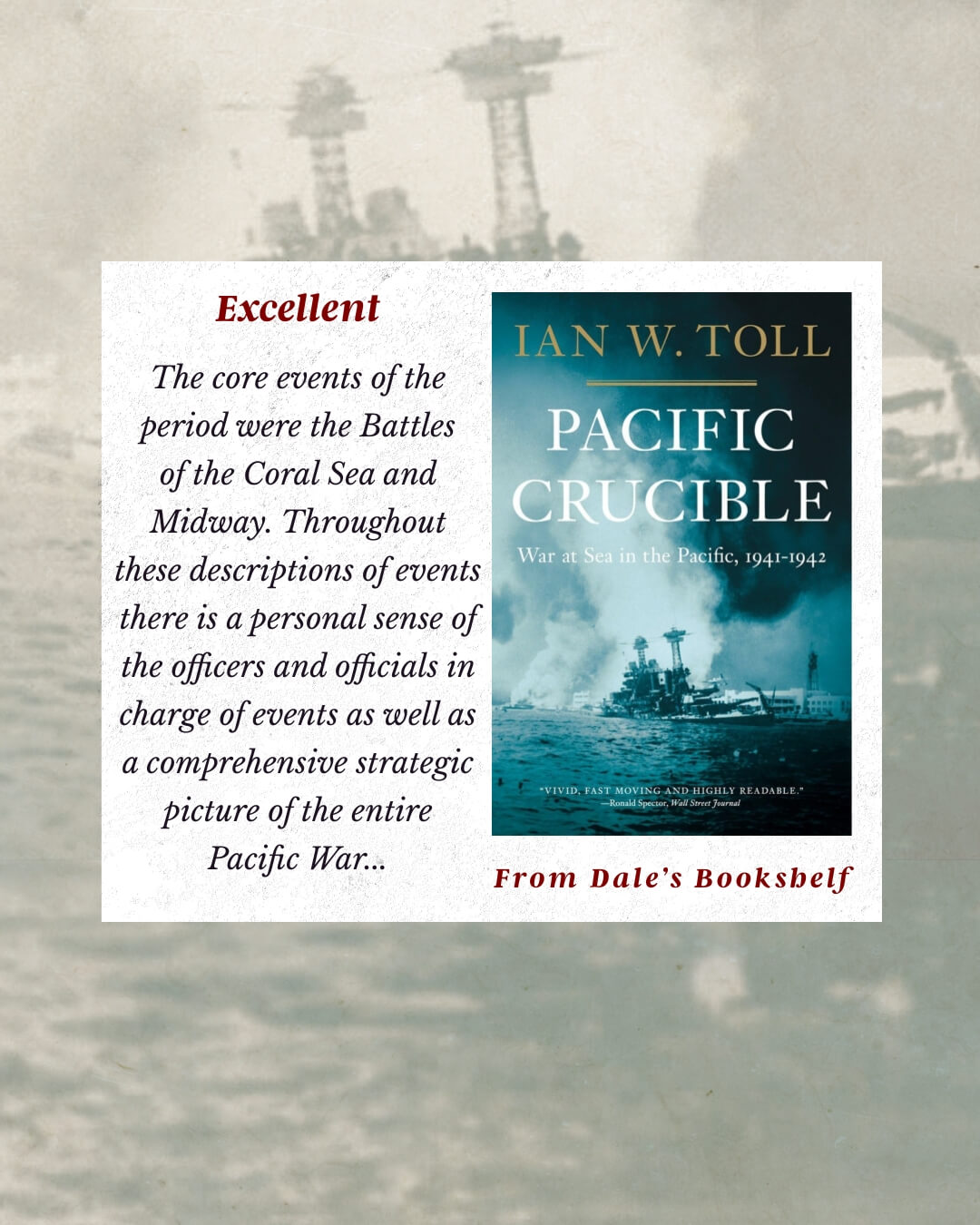
Pacific Crucible: War at Sea in the Pacific, 1941-1942
W.W. Norton & Company, 597 pages, 2012.
This is the first of a trilogy intended by Mr. Toll as a comprehensive study of the Pacific War. It begins with a vivid account of the Pearl harbor attack of December 7, 1941 and ends six months later with the great Pacific Fleet victory at Midway. In between are special mentions of carrier raids on Japanese islands early in 1942, the Battle of the Java Sea, and the Doolittle Raid on Tokyo. The core events of the period were the Battles of the Coral Sea and Midway. Throughout these descriptions of events there is a personal sense of the officers and officials in charge of events as well as a comprehensive strategic picture of the entire Pacific War.
Mr. Toll brings great historic perspective into the background of his work. He recognized that Alfred Mahan had made predictable ocean travel possible by the development of steam-powered ships that were not dependent on erratic wind power. Predictable travel meant crews not depleted by disease. Foreign bases for refueling, first coal then oil, allowed for the maintenance of organized, strong foreign empires instead of remote colonies. Steel-hulled ships combined with steam to produce new navies of power never imagined before.
No one better understood the potential of a navy built on the new capabilities better than President Theodore Roosevelt, who sent the Great White Fleet around the world from 1907 to 1909. No one, that is, unless it was the Japanese who built a comparable fleet that decimated the Russian fleet at the Battle of Tsushima in 1905. Tsushima established Japan as a world-class naval power. Tsushima remains to the present, and perhaps for the future, as the largest naval battle between steel-hulled ships.
Steel-hulled battleships continued to develop larger and more powerfully right into World War II even as their obsolescence was being shown by aircraft carriers. Mr. Toll’s description of the Battle of the Coral Sea, extending for six days in early May 1942, is a remarkable rendering of carrier strategy and tactics. Coral Sea, more than Midway a month later, was a true carrier versus carrier battle. Mr. Toll shows the scouting, tactics, calculations, mistakes, and sacrifices that occurred over those days as carriers battled each other. Some would say that Japan came out ahead by sinking one Pacific Fleet carrier while losing none of their own, but as Mr. toll points out, damages to two Japanese carriers kept them out of the Midway battle a month later, and this was the more important result.
The Battle of Midway, June 4, 1942, established the Pacific Fleet as the dominant force in the war by sinking four Japanese carriers at the cost of one for Pacific Fleet. Even though the results were dramatic, as Mr. Toll points out, the battle itself was decided more by decrypted messages, good and bad planning, deficient scouting, miscalculations, and brilliant command leadership than by carrier versus carrier battles. Because of incessant pressure and sacrifice by Pacific Fleet fliers the Japanese command was confused, and most of their planes never got into the battle. Admiral Nimitz’s intelligence unit had the Japanese battle plan decrypted a week ahead of the encounter, and this was instrumental in the Pacific Fleet victory. Mr. Toll fell into the Flight to Nowhere fiction of the Hornet air group, promoted by Bowen Weisheit forty years after the battle, which is unfortunate, but the rest of his description of the action is excellent.
Click here to read more reviews from Dale’s historical bookshelf!
 Diplomats & Admirals • Aubrey Publishing Co. LLC. • December 1, 2022 🛒🔗 Purchase Links: Amazon | Barnes & Noble | Kindle




Dear DaleWell written. I