
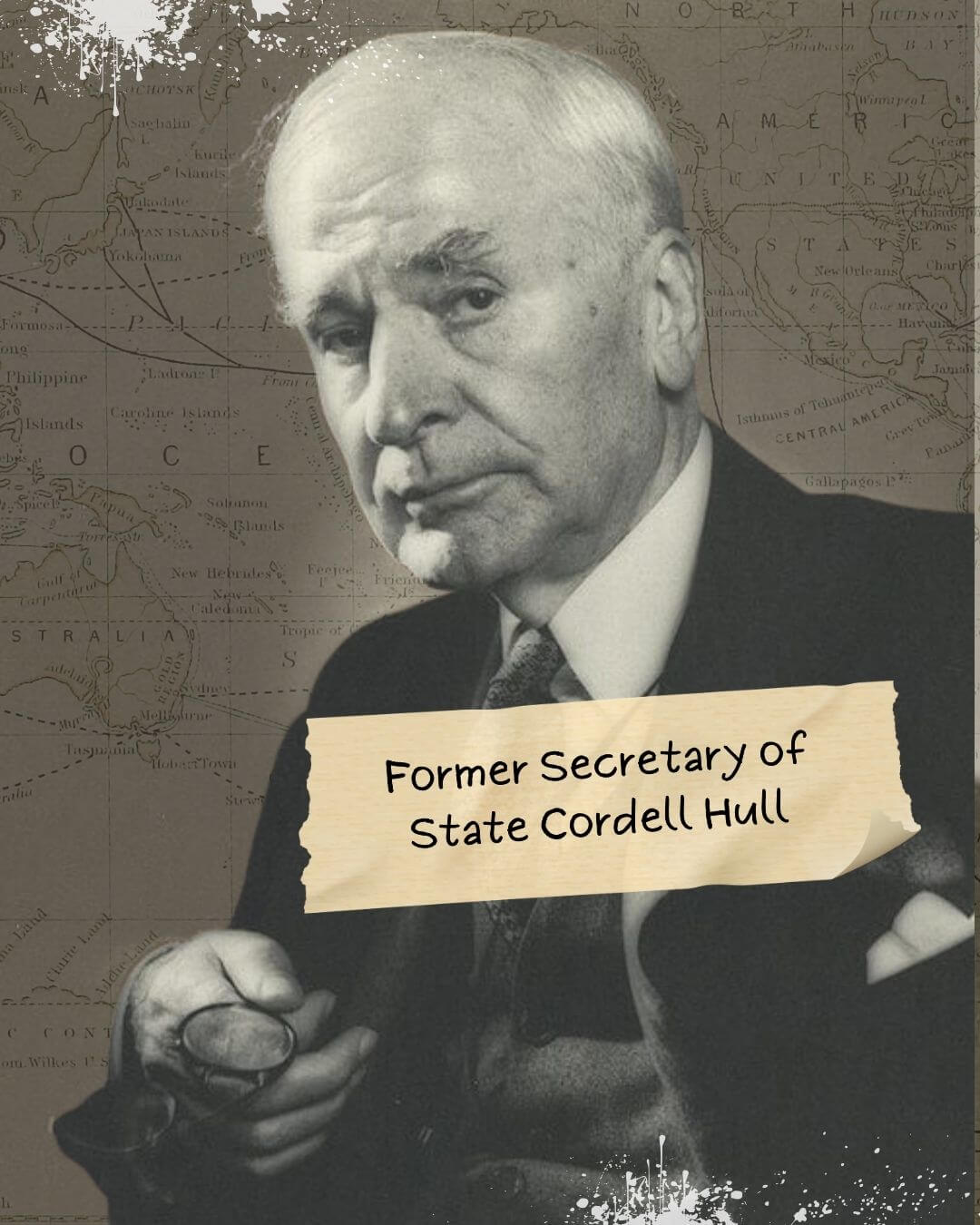
As we continue our lead-up to Pearl Harbor Day, we turn from Dean Acheson to Secretary of State Cordell Hull. In this Diplomats & Admirals excerpt, we examine the final months of diplomacy, facing stalled talks, mounting Japanese demands, and the growing realization that time—and leverage—were slipping away.
Secretary of State Hull sat at his desk in a quandary. He was concerned by the British opposition to the draft of a short-term military stand-still agreement with Japan, but could understand their apprehension about any possible lessening of US support for their interests in the Far East. However, he was completely shocked by the intense, adamant opposition from China. He was staggered by the potent Chinese lobbying effort in Washington that included the powerful influence of Chiang Kai-Shek, Madam Chiang and the Soong family throughout the US government and the Washington press. The Chinese accused the United States of appeasement of Japan, and the Chiangs used every possible ploy and exerted every ounce of leverage to prevent any sort of agreement between the United States and Japan.
For anyone to think that war between the United States and Japan was inevitable, the strong doubts expressed by the British and the strident efforts of the Chinese leadership to prevent an agreement are proof that war was not inevitable. In fact, Hull had been about to avoid war by submitting the final draft of a stand-still agreement to the Japanese diplomats. Foreign Minister Togo and the Japanese government, as evidenced by their plaintive and desperate pleas for an agreement through the month of November (1941), surely would have embraced it.
But Hull was not capable of taking that step because he had allowed himself to be controlled by opposition from governments he thought he dared not oppose, whatever the result for the United States. Hull felt stuck to his commitment to them as allies, even though their interests were very different from those of the United States. In this situation of massive, world-shaking importance, the United States had a secretary of state who was unable to maintain a policy that was critically important for the United States but questioned by the British and violently opposed by the Chinese. In failing to maintain that policy, he failed in his duty as secretary of state and failed in his loyalty to the United States. After his ineptitude was later realized, he would be described by Roosevelt as “that old fool, Hull.”
 Diplomats & Admirals • Aubrey Publishing Co. LLC. • December 1, 2022 🛒🔗 Purchase Links: Amazon | Barnes & Noble | Kindle



DaleI have enjoyed your literary pieces