
Introduction
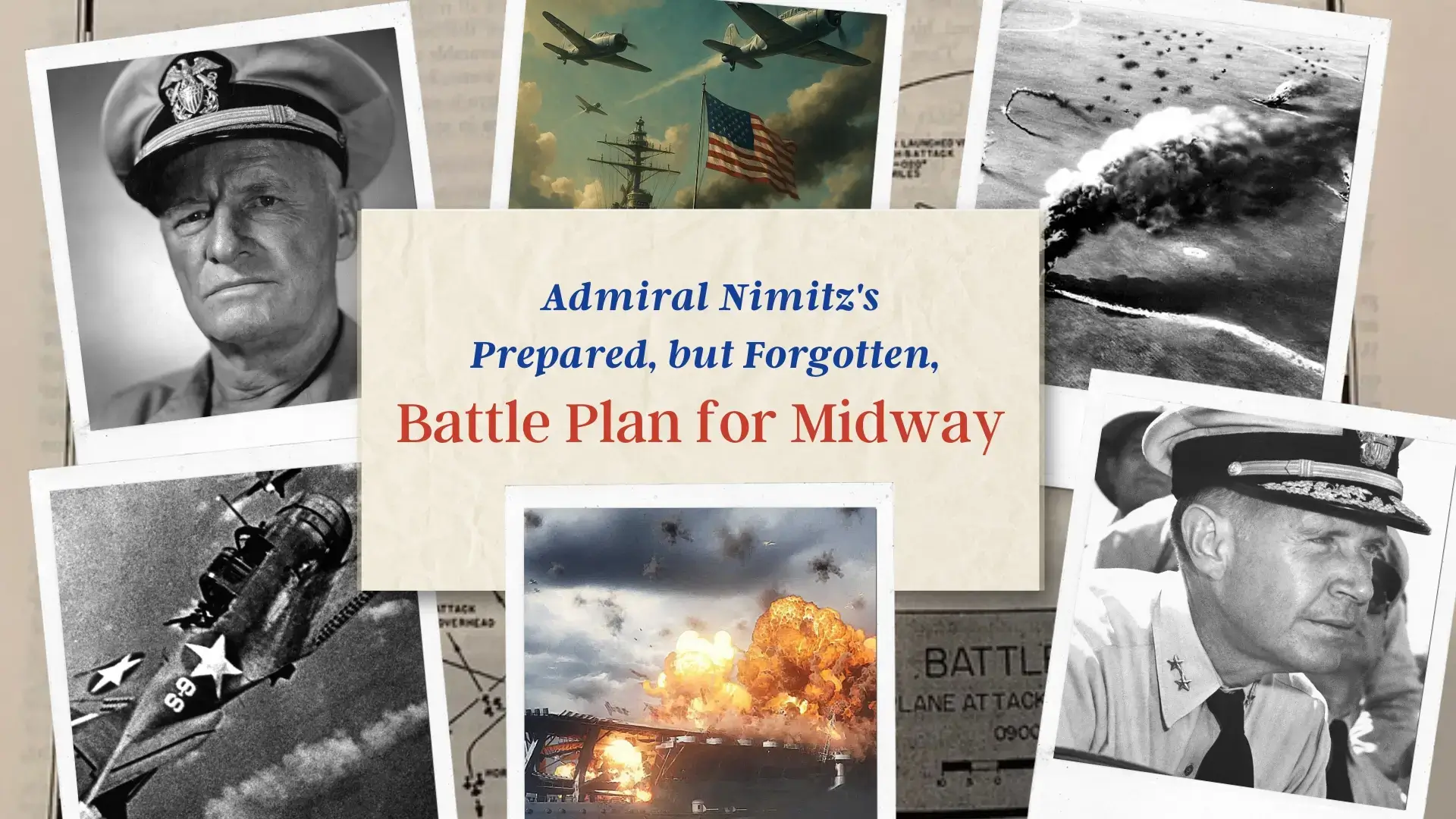
The Pacific Fleet naval victory at Midway on June 4, 1942 is one of the greatest in the history of the U.S. Navy, and one of the most significant victories in the history of armed conflict, on land or sea. Decryption of Japanese messaging a week ahead of their attack on Midway Island allowed the Intelligence team at Pearl Harbor to advise CincPac commander Admiral Chester Nimitz of the massive fleet of carriers and amphibious forces planning to invade Midway, supported by battleships and escorting cruisers and destroyers. This crucial information allowed Nimitz to formulate a plan to defend Midway and counterattack the Japanese fleet.
The Japanese proceeded with their planned attack on June 4. In the execution of the Nimitz defense and counterattack plan there were serious deviations, but positive action from a junior task force carrier commander, astute calculations by an air group commander, and intrepid, skilled flying from carrier pilots saved the day.

Admiral Chester Nimitz
Nimitz
The Intelligence team at Pearl Harbor had decrypted sufficient Japanese messages by May 27 to advise Admiral Nimitz of Japanese plans to invade Midway on June 4 and draw the Pacific Fleet carrier force into a climatic battle. The Intelligence team, headed by LtCdr Edwin Layton, informed Nimitz that the Japanese carrier fleet, or Striking Force:
“would probably attack on the morning of 4 June, from the northwest on a bearing of 325 degrees. They could be sighted at about 175 miles from Midway at around 0700 (0600 local) time.”(1)
Layton expected four or five Japanese carriers to steam directly toward Midway at 26 knots. There were four: Akagi (flagship of carrier Striking Force commander Vice Admiral Chuichi Nagumo), Kaga, Hiryu and Soryu, supported by escorts and two battleships.
Additional Japanese formations in the attack included an amphibious Occupation Force with 5000 naval infantry on transports escorted by one light carrier, two battleships, and a screen of cruisers and destroyers, all operating south of the main carrier force. The fleet movement also Included a separate force of cruisers and two light carriers to attack the Aleutian Islands, a main battleship force of three battleships with a light carrier trailing astern of the main carrier force, and another four battleships in an Aleutian screening force. The main battleship force included super-battleship Yamato with Combined Fleet commander Admiral Isoroku Yamamoto embarked. The units were disbursed to disguise the extent of their forces, but that also meant they were too far apart for mutual support.
At 0430 on June 4, when approximately 220 miles from Midway, the Japanese planned to launch half their total air complement, 108 planes, from all four carriers against the Midway shore defenses. The remaining reserve force was to be armed with anti-ship bombs and torpedoes to combat any Pacific Fleet forces that appeared, however unlikely. The light wind coming out of the southeast allowed the Japanese carriers, steaming into the wind, to launch and recover planes without changing course. When the attack on Midway began the Japanese command expected the Pacific Fleet carriers to rush to the scene from Pearl Harbor, and the Japanese carrier planes and battleships would destroy them in a showdown confrontation.
Nimitz had a week to plan a defense and formulate a counterattack. He assembled planes on Midway Island and readied three Pacific Fleet carriers, Enterprise, Hornet and Yorktown. Rear Admiral Frank Jack Fletcher, embarked on Yorktown, was the overall carrier commander and directly in command of Task Force 17, centered on Yorktown. A more junior rear admiral, Raymond Spruance, embarked on Enterprise, commanded Task Force 16 that included Enterprise and Hornet. Nimitz issued Operation Order 29-42 that detailed the forces that were to be employed, including the scouting operation of PBY amphibious planes and a picket line of submarines.
A particular problem for Nimitz was the difference in operating ranges between the Japanese carrier planes and those of the Pacific Fleet. The Japanese planes were designed to operate over long distances, and their overall operating range was 240 miles. The equivalent for the Pacific Fleet planes was just 175 miles. That difference meant the Japanese planes could attack Pacific Fleet carriers when the Pacific Fleet planes were out of range of the Japanese carriers. Nimitz had to formulate a plan that would get the carriers through the band between 240 miles and 175 miles without being spotted and attacked. The difference, 65 miles, meant that carriers covering that distance, averaging 25 knots, would have to steam for 2 ½ hours to cross the band where they were vulnerable to attack without being able to return it.
Nimitz decided to use PBYs for scouting, and these planes had two particular advantages: they had long range capabilities, and the Japanese could spot a PBY without being alerted to a carrier force in the area. To advise Nimitz on a battle plan, Layton based his calculations on the PBYs taking off from Midway at 0430 and finding the Japanese carriers at about 0600, 175 miles from Midway. Upon receipt of the PBY report the planes on Midway would launch immediately and intercept the Japanese carriers about 0720. The Japanese carriers, proceeding at 26 knots, would move about 35 miles after the 0600 report, and the interception point of the planes and the Japanese carriers would be approximately 140 miles from Midway.
Nimitz mobilized as quickly as possible a rag-tag force of planes on Midway to attack the Japanese carriers: sixteen dive bombers piloted by Marine pilots that were not trained to make high altitude, near vertical dives but only glide attacks from low altitude, six new Avenger torpedo planes, four army B-26s to be armed with torpedoes, eleven Marine Corps Vindicator bombers with fledgling pilots, and fifteen B-17s that would take off early to attack the amphibious group and then divert to high-altitude bombing attacks on the carriers once identified.
Nimitz understood that the hastily-assembled Midway planes did not maximize the capabilities of his available forces. To realize the full potential of his striking power he decided on a simultaneous concentration of force of Midway planes and carrier planes against the Japanese carrier fleet. The simultaneous attack was to be accomplished by moving the Pacific Fleet carriers under cover of darkness through the night of June 3-4 to get inside the 240-mile Japanese operating range. The Pacific Fleet carriers were to be at a position 140 miles northeast of the interception point at 0600 on June 4, well inside the operating range of 175 miles, and the same distance as the distance from Midway. That position also was 200 miles directly north of Midway Island, and 200 miles north of Midway was designated as the navigation reference point for the carrier force.
When the report from a PBY was received at approximately 0600 the planes from Midway and the three carriers would both launch their planes. In a successful execution, all the Pacific Fleet planes would arrive simultaneously over the Japanese carriers at approximately 0720 in a concentration of force. The goal was a victory by 0745-0815.
Because the Japanese planes attacking Midway would not return before 0830, the Pacific Fleet attack would be against just half of the Japanese air defenses. Nimitz ordered the attacking planes to concentrate on the flight decks of the Japanese carriers. If the flight decks were heavily damaged, even if the carriers themselves were not sunk, flight operations would not be possible, and this would prevent any counterattacks. In addition, the planes returning from the attack on Midway, low on fuel, would have to ditch in the ocean.
Midway
On June 3 the PBYs took off from Midway at 0430 and contacted the Japanese occupation force. This contact confirmed that the Japanese were proceeding with the plan as previously decrypted by Layton’s intelligence unit. The carrier force was still under a heavy weather overcast and was not discovered on June 3.
The after-action report of Rear Admiral Frank Jack Fletcher confirms the intended movements of the carrier force in conformity with the Nimitz plan:
ENTERPRISE and HORNET maintained their air groups In readiness as a striking force. During the night of June 3-4 both forces [TF-17 and TF-16] proceeded for a point two hundred miles North of Midway. (Emphasis added) Reports of enemy forces to the Westward of Midway were received from Midway and Commander-in-Chief, Pacific Fleet. These reports indicated the location of the enemy Occupation Force but not the Striking Force.(2)
The ComCruPac (Fletcher) report refers to PBY scouts on June 3, when the Occupation Force was sighted and the carrier Striking Force was still under heavy clouds. It confirms Fletcher’s knowledge of the plan and his intended movements.
As reported in Morison, “Fletcher changed course to the southwestward (210 degrees) at 1950 on June 3 with the object of arriving by break of day at a position about 200 miles north of Midway.” (3)
Further confirmation of the Nimitz plan and the ordered position of the carriers to be 200 miles north of Midway at 0600 on June 4 is contained in published accounts of at least two other contemporary historians who had the opportunity to interview participants during and after the war: Richard W. Bates and E. B. Potter. (3)
On June 4 the PBYs launched again at 0430. At 0534 a sighting of distant ships was transmitted to Admirals Fletcher and Spruance and to the forces on Midway. At 0603 the earlier report was amplified:
“2 carriers and battleships bearing 320 degrees, distance 180, course 135, speed 25 knots.” (4)
The PBY pilots did not see two additional carriers that were in the Japanese formation. Immediately after receiving this report the planes on Midway took to the air. Fighters rose to defend Midway, and the attack group commenced their missions.
However, Pacific Fleet carriers were not in position to launch planes at 0603. Fletcher, while heading southwest overnight June 3-4 toward the designated position 200 miles north of Midway, decided that the scouting as ordered in Operation Order 29-42 might not be sufficient. At first light, he ordered Yorktown carrier planes to conduct a separate sweep to the north and east. To do this the carriers had to change course into the southeast wind, both to launch and recover planes. When the 0603 message was received the carriers were 200 miles from the interception point. They were out of range and could not fly. The plan for a concentration of force had failed.
The planes from Midway arrived separately over the Japanese carriers and attacked. The Avengers and B-26s, arriving at 0710, flew into the teeth of the Zero fighter defenders. Knowing the odds were heavily against them, they did not hesitate but attempted torpedo runs against two of the four carriers. The inexperienced pilots in slower planes were hopelessly outclassed by the expert Japanese pilots flying the deadly Zeros. There were no hits or even good chances for hits, and the Zeros sent five of the six Avengers flaming into the ocean. The B-26s hardly did better, but one pilot, with his plane on fire and knowing he was probably not getting home, in a desperate act of sacrifice dove at the bridge of the Japanese flagship. He missed the bridge and Admiral Nagumo by a few feet and crashed into the ocean.
The shocked Nagumo, already notified that the Midway attack had run into heavy resistance, decided that a second attack on Midway was required. In violation of Yamamoto’s orders to maintain a defensive capability in the reserve force, he ordered the ordnance of the reserve force to be changed from anti-ship bombs and torpedoes to point detonating bombs for land targets. All of this would require over an hour to complete, and not before the Midway attack force, low on fuel, would be returning to land about 0830. With the ordnance changeover in progress Nagumo took no action to a scouting report at 0728 which alerted him to ten Pacific Fleet ships, ship types at first undisclosed.
Three quarters of an hour after the first attack began, at 0755, and after Nagumo’s battle-deciding decisions, the Marine dive bombers arrived on their glide paths but were swept aside by the Zeros with the loss of half their planes. There were no hits. The B-17s appeared fifteen minutes later and encountered no Zero defenders at their high altitude. Their bombs caused enormous explosions on the ocean but hit no ships. The slow Vindicators arrived ten minutes after that and, to avoid the Zeros, attacked a battleship. Nine of the eleven Vindicators returned.
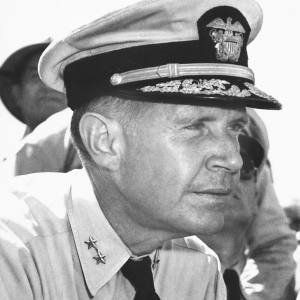
Admiral Spruance | Public Domain Photo
Spruance
After receipt of the PBY message of 0603, Admiral Fletcher detached Spruance with Enterprise and Hornet to proceed southwest and attack enemy carriers when identified. Spruance proceeded with all possible speed on course 240 degrees and thought carefully about the situation of his task force and its two carriers. Bothered by the PBY report of only two carriers in the Japanese force, Spruance considered the possibility of other carriers at a different location. He recognized that the PBYs had been flying on their search vectors for two and a half hours and probably would have encountered another carrier formation had it been out there. He also considered the possibility that the PBY pilots, coping with 50% cloud cover and trying to avoid being shot down by defending Zeros, had not seen all the carriers in the Japanese formation. He realized that without a fresh scouting report it would be foolish to send one of the air groups on a search mission for other carriers, because to do so would weaken his attack and leave just one air group to go against at least two known Japanese carriers.
Spruance decided the most probable action was to assume the Japanese fleet maintained the known course and speed. He decided to send the planes from his two carriers on a course that would intercept the Japanese on that track and ordered a course plotted that would accomplish that interception. With carriers moving with all possible speed, closing to maximum operating range of the planes meant an expected launch time of 0700. Even with some delays Spruance expected the planes to arrive at the new interception point at about 0920. Enterprise and Hornet air groups were given course 240 degrees as the most probable course to intercept the Japanese fleet.
Nagumo
At 0917, with the landing of the Midway force completed, Admiral Nagumo turned northeast to confront the Pacific Fleet force that the Japanese scout had reported at 0728. Decisions he had made, including waiting to identify ship types in the 0728 report and landing the Midway planes, had delayed any attack on the American carriers. Immediately after taking the northeast course, torpedo planes from Hornet and then Enterprise, having detached themselves from their air groups, attacked the Japanese carriers. Alone and without fighter protection, they made unflinching, valiant attacks. The Zeros shot down almost all of them without their inflicting any damage to any Japanese ship.
After two and a half hours of successfully repelling attacks Nagumo was supremely confident. Rearming and refueling the entire air complement on all four carriers would be completed by 1100. They would launch a massive, coordinated attack of over 200 planes and sink the American carrier fleet.

Lieutenant Commander McClusky | Public Domain Photo
McClusky
Allowing for an extended delay at launch, LtCdr Wade McClusky, the Enterprise air group commander, realized the Japanese would have progressed farther on their course to the southeast, and adjusted his own interception course to 231 degrees. At 0925 two squadrons of Enterprise dive bombers crossed the revised interception point but found nothing but open ocean. McClusky recognized that the Japanese carrier force probably had been delayed by earlier actions. He executed a 90 degree turn to starboard and took the two squadrons of dive bombers on a northwest course to retrace the Japanese movements. After sufficient time on that course failed to discover the Japanese, he ordered a box search that came upon a Japanese destroyer, heading northeast. Following the direction of that ship led to the Japanese carriers. Diving out of the sun at 1025, the Enterprise dive bombers caught the Japanese defenders by surprise, and in five minutes Akagi and Kaga were flaming wrecks. The Yorktown planes appeared and destroyed Soryu.
Hiryu, the remaining Japanese carrier, launched dive bomber and torpedo plane attacks which led to the loss of Yorktown. Later in the day on June 4 Enterprise dive bombers destroyed Hiryu. The great Midway victory of the U.S. Navy had been realized.
Conclusion
In the aftermath of the Midway victory no one was going to complain about not following the Nimitz battle plan, least of all Admiral Nimitz. Even though an earlier victory probably could have been achieved with fewer casualties and without the loss of Yorktown, the final victory was justifiably celebrated by U.S. and Allied forces as a major shift in the Pacific War, and with heavy implications for the entire World War II war effort. The existence of the original Nimitz battle plan has been overlooked until now.
(1) Layton, Edwin T., And I Was There, Konecky & Konecky, Old Saybrook, CT, 1985, p. 430
(2) Report of Commander Cruisers, Pacific Fleet (Adm. Fletcher), To: Commander-in-Chief,
United States Pacific Fleet, Subject: Battle of Midway, 14 June 1942, Pearl Harbor, T.H., Para. 3, included as Enclosure (H) in United States Pacific Fleet, Advance Report – Battle of Midway, 15 June 1942
(3) Morison, Samuel Eliot, Coral Sea, Midway, and Submarine Actions, Naval Institute Press, 1949, p. 102;
(4) Bates, Richard W., The Battle of Midway, U.S. Naval War College, 1948, p. 108;
Potter, E.B., Nimitz, Naval Institute Press, 1976, p. 87.
(5) Morison, p. 103.
 Diplomats & Admirals • Aubrey Publishing Co. LLC. • December 1, 2022 🛒🔗 Purchase Links: Amazon | Barnes & Noble | Kindle



Beautifully done, thanks. Al Levin
Very good.
>