
KONOE
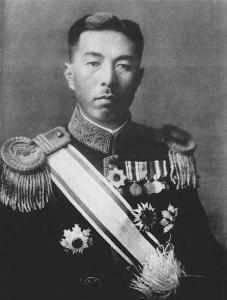
Japanese Prime Minister Prince Konoe | Public Domain Image
Japanese Prime Minister Prince Konoe faced complicated internal problems in his efforts to achieve a diplomatic solution with the United States. Attempts to achieve a unified position in the Japanese government exposed its contradictions and rivalries. There was a rivalry between the civilian and military sectors of the government, as shown by the power of the military to bring down a government if the civilians took actions contrary to their views. There was a bitter rivalry in the armed forces between the Army and the Navy, which had at its core a battle for power in the government. Within each armed service there were moderates, who saw the need for diplomacy to avoid a war with the United States, and pro-war hardliners, who believed the power of the samurai fighting spirit would overcome any material and resource imbalance. Within the latter group were those who would rather fight and die in a glorious defeat than succumb to the humiliation of slow strangulation from the oil embargo. Finally, there were contradictions within individuals, who in large meetings boisterously and confidently advocated aggressive actions, and later privately admitted to close confidants their concerns about Japan’s ability to win a war with the United States. The public bravado was most evident when important decisions were made in large or important group meetings, such as Imperial Conferences. These decisions, however, were difficult to reverse or even modify as circumstances or opinions changed because of the Imperial Mandate attached to such decisions.
Konoe made a huge effort to bypass all these conflicting elements by doing everything he could to have a one-on-one summit meeting with President Roosevelt. Coming from an aristocratic background and building on relationships he had developed on the international scene since the Great War, he moved easily in the company of trusted equals. He was confident he could reach an agreement with the patrician Roosevelt if a meeting could be arranged.
The German invasion of Russia changed the basis of the Tripartite Pact that Japan held with Hitler, but the Army would not agree to a revocation. Secretary of State Hull viewed the pact with Hitler, the most hateful person on the planet, in a very negative light, and was highly inflexible in any discussions with the Japanese diplomats. Konoe struggled with all these conflicts. Konoe’s success or failure in achieving the summit with Roosevelt determined the success or failure of his government, and ultimately the success or failure of Japan.