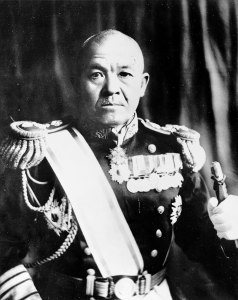
Vice Admiral Nagumo | Public Domain Photo
Japanese Vice Admiral Nagumo had made his career on cruisers and battleships. When he was assigned command of the carrier Striking Force, his seniority meant that he was never required to get into the details of flight operations, nor did he make the effort to do so. He depended on his experts, Commanders Fuchida and Genda, for that. But now, at the critical and perhaps deciding moment in the Battle of Midway, both were debilitated and out of action – one with a high fever, the other with appendicitis. Nagumo was suddenly on his own. At this decisive time, the cost of his failure to learn the complicated factors that played into carrier operations suddenly came due. Now, when every minute counted, it was too late to learn the complexities involved in loading different munitions on different types of planes on the hangar deck, too late to learn how the planes were organized and spotted on the flight decks, too late to learn the flight capabilities of the different types of planes, and far too late to know how to integrate all those factors into a fast-moving and efficient operation with the planes and ordnance available at that moment. Commander Genda, his brilliant operations officer, couldn’t make the decisions for him now. It was all up to Nagumo. At 0730 on June 4, 1942, years of shipbuilding, training, and strategic planning had all come to this moment. Squadrons of highly trained pilots, flight deck personnel, mechanics, and hundreds of other sailors were ready and awaiting his command. The entire course of the battle, of the Combined Fleet, and even perhaps of Japan were going to bear the results of his decisions, then and there.
