

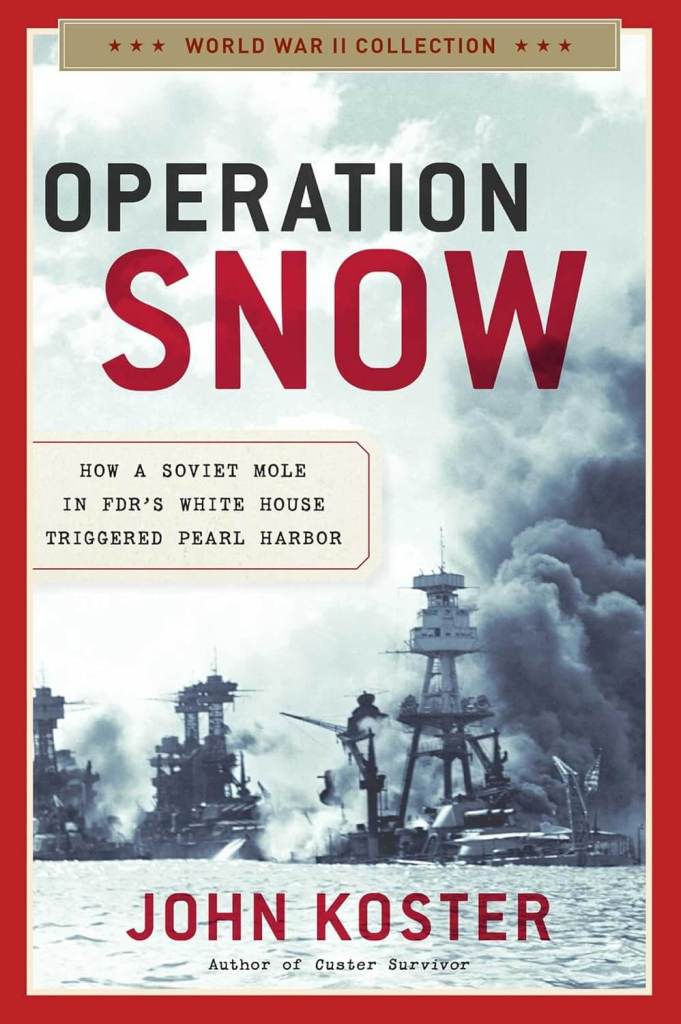
Regency Publishing Inc., Washington, DC. 2012. 250 pages.
Operation Snow provides an incisive description of the Soviet spy operation that operated in the United States from the 1930s through the end of WWII and even beyond. Most significant was the part it played in the United States entry into WWII.
The NKVD, the Russian spy operation prior to its evolution into the KGB in 1946, found some willing converts amongst members of the intelligentsia in the US government and other entities who came to believe that communism was the wave of the future. Persons that played active roles became traitors to the United States. Prominent in this category were Alger Hiss, an advisor in the office of Secretary of State Cordell Hull, and, the primary subject of Operation Snow, Harry Dexter White.
White was an official of the Treasury Department and a close advisor to Secretary of State Henry Morgenthau. Educated as an economist and conspicuously smart, White played a continuous role in shaping US economic policy in subtle ways that benefited the Stalinist regime. His most important assignment from his NKVD handlers was to precipitate a war between Japan and the United States. The objective of a US-Japan war was to commit Japan’s army to fighting the United States, thereby preventing an invasion of Siberia and allowing the Russian army to concentrate on its western front against Hitler. An invasion of Siberia by Japan could have led to a defeat by Hitler’s army in the Russian west.
Operation Snow presents a detailed history of Japanese diplomatic and military operations in the decades prior to WWII, including important insights into the internal workings of the Japanese government and its military organization. Frequent assassinations of high Japanese officials kept the government in continuous turmoil.
The Russians had not forgotten the resounding defeat of their battleship fleet at the Battle of Tsushima in 1905, and the Japanese expansion into Korea and Manchuria created conflicts on the Russian-Manchurian-Korean borders. More serious armed conflicts occurred in 1938-1939. The Russians were constantly alert for any opportunity to stab Japan in the back.
With the outbreak of WWII and Hitler’s invasion of Russia in 1941, Japan saw an opportunity to finish off Stalin by opening a second front in Siberia that would keep his army divided and precipitate a German victory in the Russian west. The Japanese generals were watching the progress of the German armies approaching Moscow, and an impending collapse of Russian resistance would be the signal for the Japanese to invade Siberia. On page 163 of Operation Snow Mr. Koster describes the desperate situation with the German army on the outskirts of Moscow.
“With the Wehrmacht at the gates of Moscow and Leningrad, Russian morale was crumbling. NKVD detachments were placed behind Red Army positions to shoot deserters. Then hundreds of thousands of reinforcements and more than a thousand tanks arrived from Siberia and Mongolia, freed up by the war between Japan and the United States. Snow fell at the same time, and the Russians stopped the Wehrmacht in its tracks.”
Perspective to this huge shift in the war is available in several historical sources. Perhaps the best is the Robert Whymant 1996 book, Stalin’s Spy. An excerpt from Diplomats & Admirals, based on this and other sources, adds background to account of the Russian reinforcements that arrived to defend Moscow:
“The most successful spy in the war on any side was Richard Sorge, a German and Nazi Party member operating as a journalist in Tokyo, but in fact working for Russia. Sorge was a wounded German veteran of the Great War who had come to believe in communism, and that belief determined his ultimate loyalty. He built a small network of spies in Tokyo, and through various sources uncovered important information that he fed to Stalin.”
“In August, 1941, Sorge had his spies following the massive Japanese military move to Manchuria, collecting every available scrap of information. Finally, on September 14, a member of the Sorge ring returned from Manchuria with the information that the Japanese buildup in Manchuria was being reversed. A message went to Stalin with that crucial information. This was the most important intelligence information that was obtained by any spy in the entire war.”
“Stalin, with the information from Sorge and confident that no attack could be made after mid-September, began transferring his Siberian forces to the west. By the first week of December, 18 divisions of troops, 1,500 tanks, and 1,700 planes had been moved west to defend Moscow. The final German assault on Moscow was repulsed, and the decline of Hitler began.”
Turning to the activities of Harry Dexter White, Mr. Koster identified on page 132 the measures both Japanese and Americans were taking to avoid war in late November, 1941. He understood that war was not inevitable, and states:
“They (the Japanese) agreed to pull out of southern Indochina as soon as their oil was restored and to leave Indochina completely once peace was made with China.”
Mr. Koster recounted how White devised an ultimatum to be delivered to Japan to provoke a rejection of peace overtures and precipitate war. The ultimatum was composed as a note containing ten onerous demands, that became known as the Ten Point Note. In the Koster account, White was successful in getting this note to be the basis of the US diplomatic position. The terms of the note were inconsistent with the negotiations that had been taking place and would be completely unacceptable to the Japanese. White expected that when the note was delivered to the Japanese diplomats and relayed to Japan it would precipitate war.
Although the Ten Point Note ultimately was delivered to Japan on November 26 and was the final meaningful diplomatic exchange before Pearl Harbor, a full understanding of those crucial last days of November shows that other events took place prior to November 26 that could have avoided war. The White-drafted Ten Point Note followed only after other attempts failed. Roberta Wohlstetter’s book, Pearl Harbor: Warning and Decision, published by Stanford Press in 1962 and Eri Hotta’s Japan 1941: Countdown to Infamy recount how in late November the Japanese army softened their previously adamant position and agreed to withdraw from southern Indochina in exchange for a resumption of oil shipments. This was incorporated by US Secretary of State Cordell Hull into a draft note agreement dated November 22 that called for a three-month modus-vivendi, which he circulated to the US “allies”—British, Dutch and Chinese—for their approval. The Ten Point Note, as stated in Wohlstetter, page 236, was “…a basis for long-term discussions of Japanese-American differences, to be undertaken only after acceptance of the modus-vivendi.”
The reply to the modus-vivendi from the Dutch, operating from London, was amenable. However, the British expressed strong doubts and Chiang Kai-Shek was adamantly opposed. He replied in strong language and copied all possible parties, including Churchill in London and the Washington media, to claim the modus-vivendi constituted appeasement of Japan. A document in Foreign Relations of the United States Diplomatic Papers contains the Chiang reply:
If . . . there is any relaxation of the embargo or freezing regulations, or if a belief of that gains ground, then the Chinese people would consider that China has been completely sacrificed by the United States. The morale of the entire people will collapse and every Asiatic nation will lose faith, and indeed suffer such a shock in their faith in democracy that a most tragic epoch in the world will be opened. The Chinese army will collapse, and the Japanese will be enabled to carry through their plans, so that even if in the future America would come to our rescue the situation would be already hopeless. Such a loss would not be to China alone.
Upon receipt of this communication from Chiang, Secretary Hull should have realized he was not beholden to China, and it was in the interests of the United States, Japan, and even China to proceed with the modus-vivendi. An agreement to it would have avoided war with Japan. Instead, he capitulated. Feeling that he could not proceed with a note that Chiang opposed, he fell back on the only other document that had been prepared, the Ten Point Note, and delivered it to Japan. White succeeded only as a result of the weakness and incompetence of the United States secretary of state. The Japanese government rejected the Ten Point Note, and Pearl Harbor followed.
A final contribution of Harry Dexter White to the bloody history of WWII is found on pages 166-168 of Operation Snow. In late 1944, in view of the impending defeat of Germany, plans for post-war Europe were being considered. Secretary Morgenthau proposed a plan “almost certainly drafted by White” to eliminate industry from Germany and turn it into a poor agrarian society. While this was posed as a safety measure to forestall any resurgence of Germany in the future, it also meant a weak Europe that the Russian army could overrun all the way to the Atlantic Ocean.
Although the Morgenthau plan was never implemented, in late 1944 it was leaked to the German army and citizenry. So appalled were the Germans at this prospect that they reversed their strategy to fight resolutely in the east against the Russians, and instead fought in the west to stop the Allied eastward movement and the implementation of the Morgenthau plan. The result was the Battle of the Bulge with thousands of American GIs killed and the delay of the Allied advance into Germany. The result was the Battle of the Bulge with
thousands of American GIs killed, the delay of the Allied advance into Germany, the Russian occupation of eastern Germany including Berlin, a divided Germany, and a cold war over the next four decades. Hitler’s actions in this recounting are not mentioned.
The final chapters of Operation Snow recount how the Russian spy ring was finally exposed after the war, how the White testimony before the House Un-American Activities Committee identified him as a spy, and his death, perhaps by suicide, before he could be indicted.
Despite several modifications referred to above, the book is an excellent read of the pre-WWII period, particularly the Russian spy operations, the tumultuous events inside Japan, and the treacherous life of Harry Dexter White.



Hi Dale . . .thanks for sharing your book review . . .fascinating and very plausible recounting of White\’s nefarious activities. You are becoming quite an expert on the pre-WWII period in late 1941. I am in Athens as I type this on a family trip. I gaze at the Acropolis and think of the Athenians and what they did to create and preserve their republic, and what DJT is doing to deconstruct ours. Resist we shall and must. It took a jury of 501 Athenian men to convict Socrates – now that\’s due process! Let\’s get together in January in FL. Stay well.Bill