
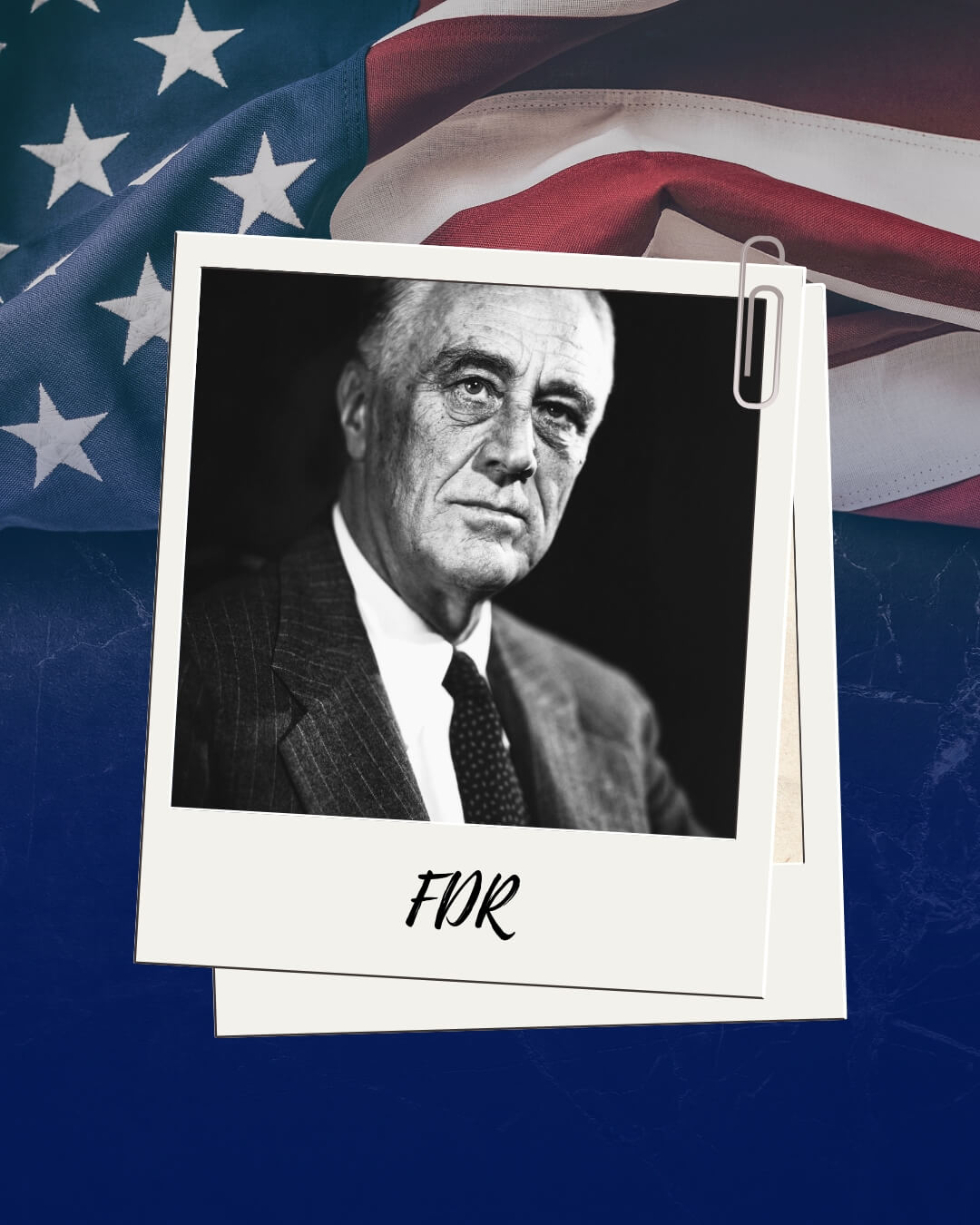
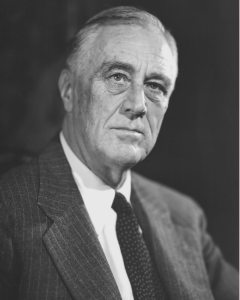
FDR – Public Domain Photo
In 1941, as the United States faced the threat of another horrific war, President Franklin D. Roosevelt was leading the nation from a wheelchair. Struck down by paralytic polio at age thirty-nine, he rehabilitated and marshaled himself, despite severe pain, to press on with his career in politics. Eleven years later, delivering his message of confidence and optimism, he was elected President of the United States.
Many people who lose a sense, like eyesight, compensate by developing keen hearing, touch, taste, or smell. In Roosevelt’s case, his legs were paralyzed. Without assistance he could not move. Limited to thinking and speaking, he developed those capabilities to make himself one of the great communicators of his age.
The only child of a wealthy and privileged family, he grew up in a large, spacious home in Hyde Park, NY, an exclusive enclave north of New York City. He was educated at a young age by private tutors. Later at secondary school both his strong-willed parents encouraged him to compete and excel at his studies and sports. Frequent trips to Europe broadened his perspective. He was proud of his family and its history that went back to the seventeenth century in America.
As president he had great personal magnetism that inspired loyalty in virtually everyone around him, but despite his expansive outward style he was inwardly secretive. He had an indecipherable agenda that he shared with no one. He had an independence of mind and extraordinary personal confidence, and he did not hesitate to make decisions – or to make subsequent decisions modifying, sometimes significantly, the first ones when that suited his purposes.
He was a genius at mass communications, and his speechwriters deferred to his reviews of their drafts, not so much because he was the president, but because when a text required the perfect word, the exquisite or incisive phrase, or exactly the right tone, he was the best. And when it came to delivery, he had no peer. He spoke on the radio from the White House thirty times between March 12,1933 and June 23, 1944 in the friendly, confident, and inclusive tones that were described as Fireside Chats. During the Fireside Chats half the country tuned in, and it was said that on hot summer nights when people had their windows open one could walk through the residential downtown of a large city and hardly miss a word.
“We must be the great arsenal of democracy. For us, this is an emergency as serious as war itself.” —FDR
 Diplomats & Admirals • Aubrey Publishing Co. LLC. • December 1, 2022
🛒🔗 Purchase Links:


0 Comments