
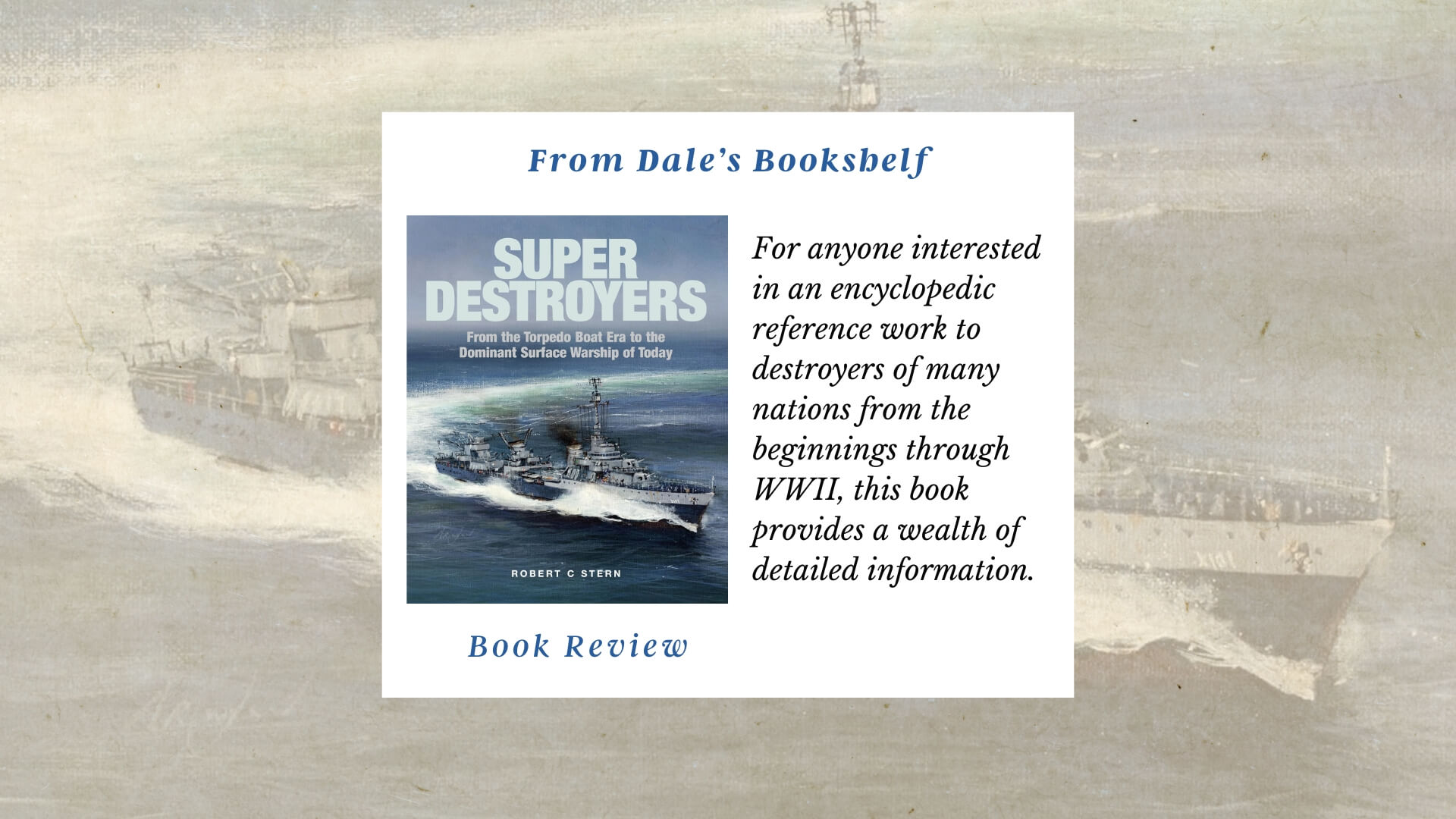
Robert C. Stern, Super Destroyers, Seaforth Publishing (Imprint of Pen & Sword Books., Ltd.), 255 pages, 2024.
Mr. Stern, a resident of Alameda, CA, has written nine books , mostly of a maritime theme. A previous book, Destroyer Battles: Epics of Naval Close Encounters, published in 2008, recounted some of the most significant or unusual actions in the history of destroyer warfare.
Super Destroyers is a comprehensive description of the varied ships that fall in the destroyer class. It is international in scope and includes descriptions of ships flying the flags of United States, Great Britain, France, Germany, Italy, Japan, Russia, and Australia. It begins with the earliest steam-powered launches in the 1870s that were designed to fire torpedoes at close range. The need to be effective at longer range provided incentive to design larger, faster ships and torpedoes with greater effective range. The earliest ships depicted were British, and this evolved into those of the U.S. Navy and others as the book progressed.
The U.S. Navy developed four-stack, flush-deck destroyers used extensively in WWI. The Sims class of the 1930s with 5-inch guns and midship torpedo tubes led into the classes of ships that fought WWII – Benson, Fletcher, and Sumner. Paralleling these descriptions were those of other navies, particularly those of the Royal Navy, but also those of Germany and Japan. The descriptions of the ships formed the major portions of the book. Also included was a play-by-play account of an engagement of Royal Navy destroyers with German naval forces in early 1941.
Looking ahead, Mr. Stern describes the design of the Forest Sherman and Spruance classes, evolving to the Arleigh Burke class in the 1980s which, perhaps the longest-running design in history, is still being built today. Scant attention is paid to the Burke’s, however, and just a page or so to the Zumwalt – a ship that remains a work in process.
For anyone interested in an encyclopedic reference work to destroyers of many nations from the beginnings through WWII, this book provides a wealth of detailed information. His Destroyer Battles of 2008 might be more interesting reading, as indicated by his description of the 1941 encounter in Super Destroyers. It also seems to be unduly slanted toward ships of the Royal Navy and, given its publication by Pen & Sword, makes me question whether it is not really a British publication.
For more reviews of history books from my shelves, 🔗📚👉🏻 click here!


Thanks for the reference, Dale!
Cheers,
Fred
Frederick J. Passman, CAPT, USN, Ret.
Commander General (CG)
Naval Order of the United States (NOUS)
commandergeneral@navalorder.orgcommandergeneral@navalorder.org
passcapt@live.compasscapt@live.com
Naval Orderhttps://www.navalorder.org/
[cid:image001.jpg@01DD29BA.31032B10]
Dale: Living and working