
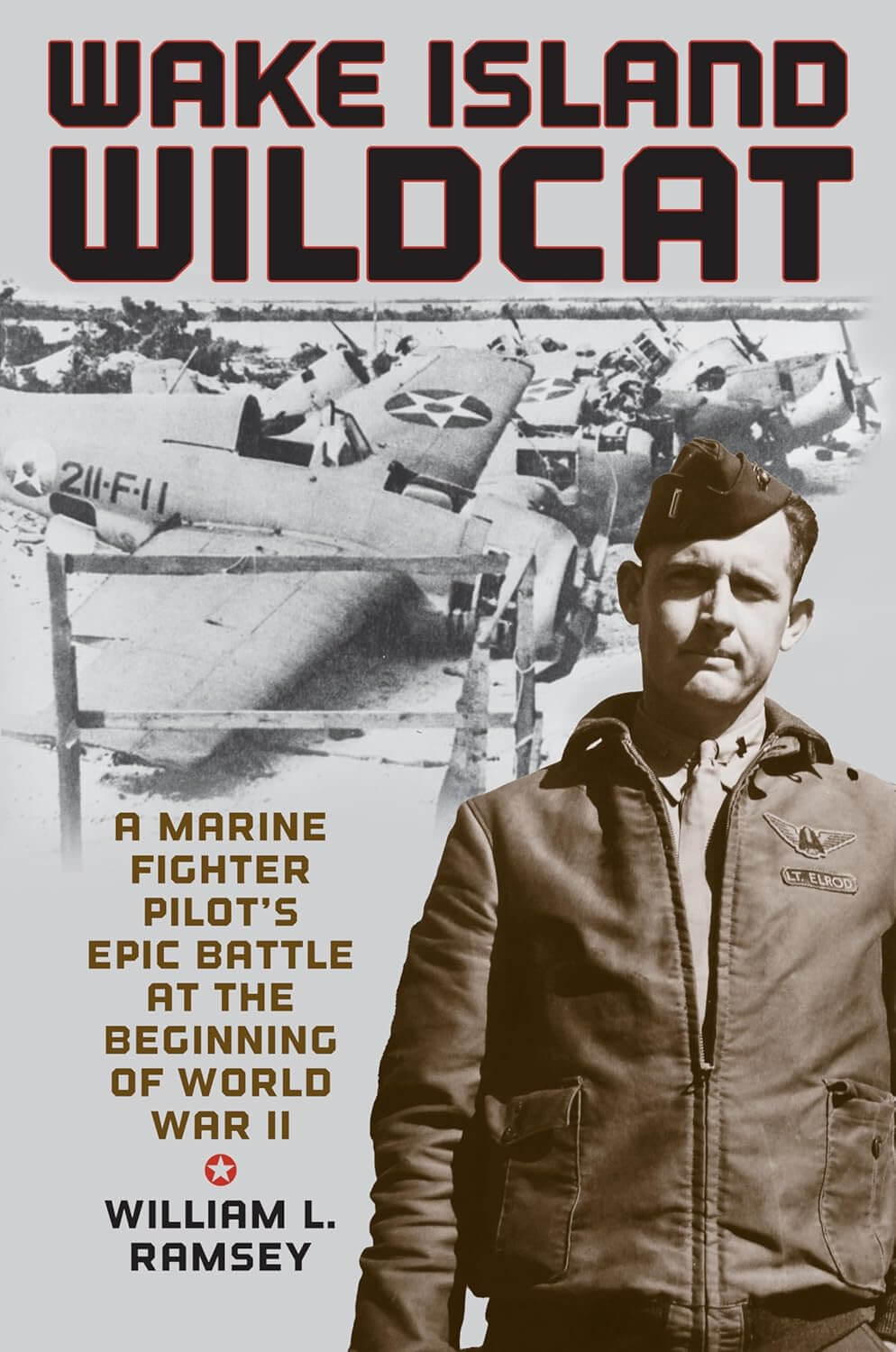
William L. Ramsay – Wake Island Wildcat – A Marine Fighter Pilot’s Epic Battle at the Beginning of World War II, Stackpole Books, 2024.
Book Review by Dale A. Jenkins
William L. Ramsey is a professor of history at Lander University, and previously taught at SUNY and University of Idaho. He received a Ph.D. from Tulane University. An author of several previous books, Wake Island Wildcat is a personal project to record the life of his great-uncle, Henry Talmage Elrod.
Henry Elrod was born in rural Georgia in 1905. From his earliest childhood he was a rebel, frequently in trouble over pranks at his schools. As a child he was fascinated by airplanes, an industry in its infancy at that time. He attended college in Georgia, transferred to Yale, but dropped out after a year to enlist in the Marine Corps.
As a Marine private he worked as a clerk and armorer at North Island naval station, wrangled flying lessons, and took every opportunity to fly whatever planes were available. Seeing this determination, he was chosen for flight school at Pensacola. He continued his flying career in the Marines in various commands over several years, earned a commission, became known as “Hammerin’ Hank,” and ultimately flew the most advanced fighter, the F4F-3.
In December, 1941, as a captain, he was second in command of the fighter squadron flown off the Enterprise to Wake Island. He would end his life on Wake Island, and his exploits there would earn him a Medal of Honor. The Marine Corps named a street at Quantico in his honor, Elrod Avenue. The Navy named a frigate after him, USS Elrod (FFG-55). His portrait hangs in the Hall of Honor at the National Naval Aviation Museum at Pensacola.
In a mission that was first described as routine, Henry Elrod arrived at Wake Island a week before the December 7 attack on Pearl Harbor with an F4F squadron to supplement the existing Marine ground forces. Within hours of Pearl Harbor, Japanese bombers from the Marshalls attacked military and civilian installations. There were heavy casualties and eight of the twelve F4F fighters were destroyed. However, the Marines repelled an invasion attempt three days later, and Elrod sank a destroyer by dropping a 100-pound bomb on the ship’s depth charges. The Japanese made daily attacks on Wake, and Elrod flew against the bomber fleets, shooting down at least six planes.
Despite inflicting losses on Japanese bombers, there were inevitable losses of remaining Marine fighters. With all planes finally destroyed, and faced with a huge invasion of Japanese amphibious forces on December 21, Elrod joined the ground forces and commanded a machine gun unit at water’s edge. As the invasion intensified he stood his ground, firing a sub-machine gun at the invaders, and was killed. His promotion to Major came a week after his death. He left behind a loving wife and family who were not informed of his disposition until many months after the Japanese took Wake. After the war, his body was identified and buried at Arlington in a ceremony attended by President Truman.
William Ramsey has produced a well-written, comprehensive story of the life of Henry Elrod. As evidenced by his notes, his research was extensive. It is an important addition to our knowledge of Wake Island and is a tribute to a great American. In this era of polarization and expediency, a recognition of great patriotism is worthy of our serious consideration.


0 Comments