
Almost every year we celebrate a new anniversary of an event of WWII as they are recognized in five-year increments. This year, 2024, it is the eightieth anniversary of D-Day. Three years ago, it was Pearl Harbor and our patriotic flag-waving entry into the war. Two years ago, it was the Battle of Midway. Next year it will be the surrenders of Nazi Germany and Japan. In all this there is the sense of resolution and triumph, and that leads to a vague sense of confidence that the United States might be late getting into a major war, but we always get mobilized and come out on top. Interim unpleasantries since the war, such as our various withdrawals from untenable situations, are minimized. Vietnam will be swept under the historical rug as soon as the agonized survivors and the families of the 58,000 Vietnam dead pass from the scene. World War II will remain as the ultimate triumph.
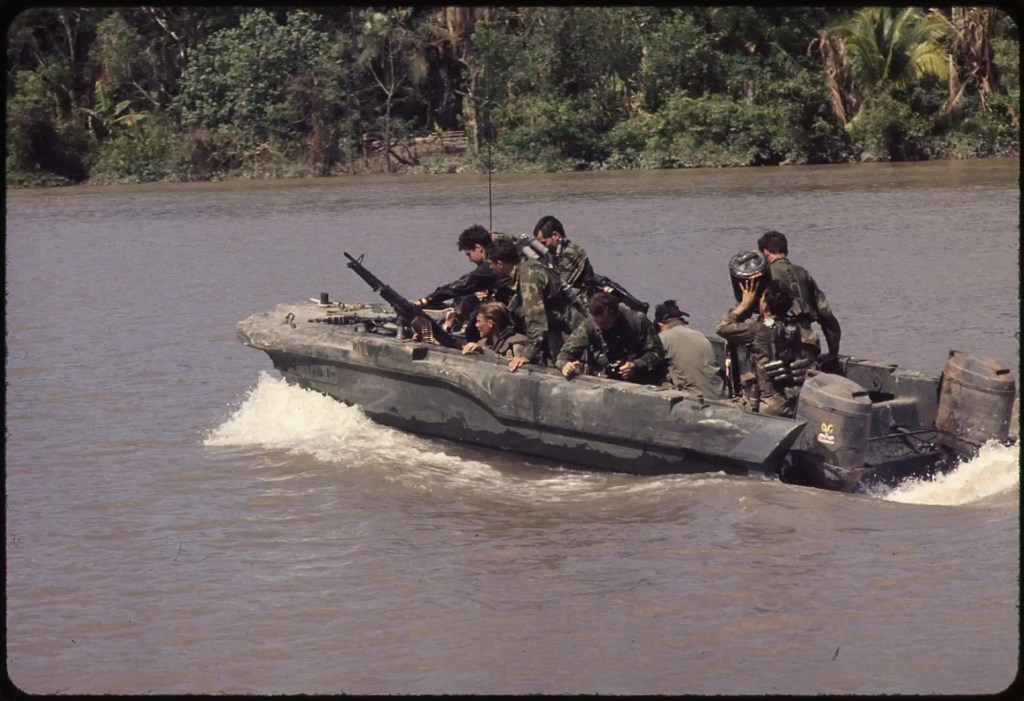
The Republic of Vietnam…U.S. Navy Seal Team One members move down the Bassac River in a Seal Team Assault Boat (STAB) during operations along the river south of Saigon. Source: National Archives
A closer look at just two events from World War II brings about a more sobering appraisal. The attack on Pearl Harbor, Dec. 7, 1941, was a dramatic, unexpected event in which the Japanese six-carrier fleet transited 3700 miles across the stormy north Pacific Ocean, refueled underway, and arrived undetected at Pearl Harbor to destroy the battle line of the Pacific Fleet. Even today such an operation would be considered a major accomplishment.
The scene in the operations room aboard the battleship Nagato as Admiral Yamamoto reviewed the reports of the successful attack is described in Diplomats & Admirals. As the exultation of the staff officers and sailors swirled around him, Yamamoto, sensing the irresolution of his carrier commander, fixed a steely gaze on his chief of staff, and in a quiet but intense voice: “Admiral Nagumo is going to withdraw.” That is exactly what happened. The first wave of the second attack, rearmed and refueled, was already spotted on the flight decks of the carriers. They were ordered down to the hangar decks, and the carrier force took a course to the northwest, back to Japan.
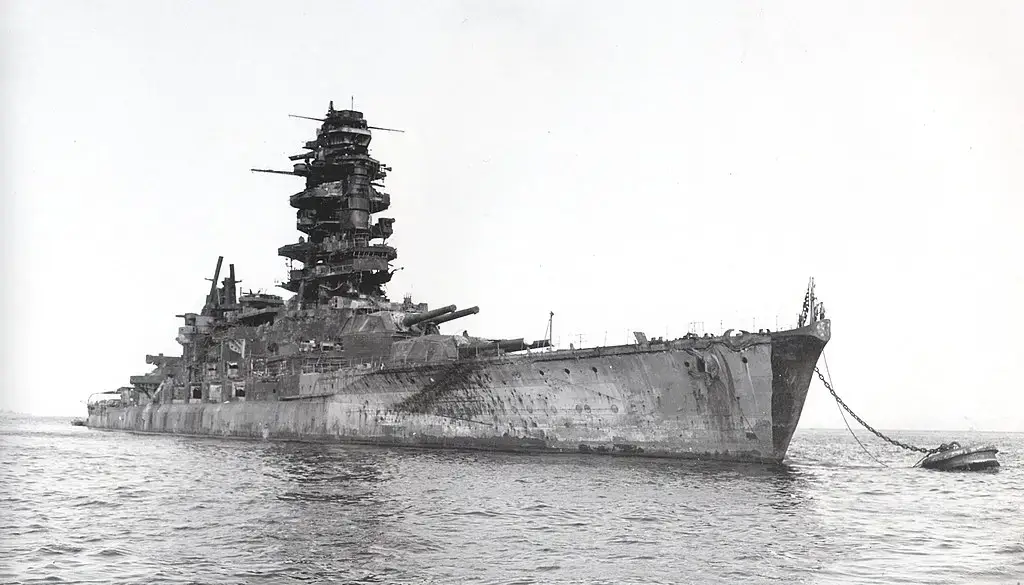
Japanese Battleship Nagato
Pearl Harbor could have been worse. The alternative was another launch and an inevitable encounter with US carrier Enterprise in a six-to-one matchup. A day later, Lexington would have rushed into the battle zone for another six-to-one matchup. In between those encounters, the Japanese carrier planes could have struck the open emplacements for the 16-inch guns at the harbor entrance and allowed the two battleships attached to the carrier force to move in for shore bombardment of the fuel tank field, submarine base, repair facilities and other ships in the harbor. Any remaining US forces would have withdrawn to the US west coast. The war would have been longer, and the events that would have followed are far from easy to predict.
The Battle of Midway, June 4, 1942, is rightly memorialized as one of the great victories in the history of the US Navy. It is celebrated every year in Navy circles and deserves a wider recognition in public perception as the first victory of any Allied power, anywhere in the world. It was a turning point in the war. But it easily could have turned out differently. Nimitz realized the risks and sent a message to his afloat commanders instructing them that their actions be “governed by the principle of calculated risk.”
Admiral Nimitz planned a concentration of force of carrier planes and planes flying from Midway Island to meet simultaneously over the Japanese carrier force around 0720. That was the best opportunity for a US victory, but it was hardly assured. The Japanese search starting at 0430 could have been executed with the same number of search planes as the US used, 22 – instead of 7 that the Japanese used. In that case a search plane’s discovery of the US carriers could have been at 0600 instead of 0728 – the time they discovered the US carrier force. The Japanese command would have launched the reserve force of half their planes while others were attacking the defenses on Midway. This meant that both forces, Japanese and American, would have launched planes about the same time against their opposing carrier fleets. The Japanese had left their best pilots in the reserve force because, in the event of an encounter with enemy ships, greater skill was required to hit maneuvering ships. The less experienced pilots could carry out the attack against static land targets on Midway. At that point in the war the Japanese had the edge in seasoned pilots and higher performance planes. The odds in that circumstance would have been no better than 50-50 for a US victory. In the actual events, the Japanese failed to launch the available planes from their reserve force upon receiving the scouting report at 0728 – and lost their best chance to win the battle of Midway.

Battle of Midway Pacific Map
Suppose, however, that the expanded Japanese search discovered the US carrier force in its actual position on June 4 – about sixty miles east and slightly north from its intended 0600 position at about 0620. This position was about 200 miles from the Japanese carrier force. The US planes were beyond their operating range of 175 miles, but the Japanese were within their operating range of 240 miles. In that scenario the Japanese would have launched immediately, and Admiral Fletcher would order, as he did, the more junior Admiral Spruance to “Proceed southwesterly and attack enemy carriers when definitely located.” At that point the odds for a US victory at Midway drop to 25%, if not lower.
Fortunately for the US forces, the Japanese did not execute a competent search on June 4. The US planes launched at 0700 after closing the range, and after some delays flew on their attack courses after the Japanese scout was spotted over their ships at 0728. There was no back-up scouting because the scouting planned for the concentration of force was believed to be sufficient. The only information available for the location of the Japanese carrier force was a report from a scouting PBY received at 0603. Everything was dependent on the Enterprise and Hornet air group commanders making correct judgments to find the Japanese. By 0917 the Japanese had recovered their Midway attack planes. They knew where the US carriers were from the 0728 report and changed course to attack while refueling and rearming their full complement of planes. At that point the odds for the Americans were no better than 25%. The Hornet air group commander went in the wrong direction. The Enterprise air group commander, with two squadrons of dive bombers and running very low on fuel, could have turned back to his carrier. Instead, he executed two crucial course changes and luckily encountered the Japanese destroyer that guided him to the Japanese carriers just before they were ready to launch their attack. The rest is history.
The point of all this is that complacency is not to be tolerated. The US survived Pearl Harbor with damage to increasingly obsolete battleships instead of devastating damage to the carrier fleet and the Pearl Harbor naval base primarily due to deficiencies in the Japanese command. Midway was a win for the US Pacific Fleet by the judgment and bravery of its carrier pilots, but equally by the Japanese grossly insufficient scouting and delay of their attack when a scout finally reported contact. No one drew attention to the original Nimitz battle plan, least of all Nimitz.
Are we to assume that in the current circumstances of 2024 we can drift along with insufficient naval forces, then scramble quickly to pull off another win when necessary? Are we ready for encounters against potent forces in the western Pacific, the Red Sea, the Persian Gulf, the Baltic Sea, and the Mediterranean? We are not, and specific moves must be made to get us ready, and plans developed for alternative resources until we are ready.
Want even more insights into this article? Watch Dale’s presentation at the National Museum of the Pacific War, which is now showing on YouTube:
The Nimitz Battle Plan for Midway: Insights from Dale A. Jenkins

Click to Watch!


0 Comments